Before You Create Anything: Finding Your Focus in the Digital Creator World
Stop chasing every trend. Learn how finding your focus in the digital creator world builds a content direction that fits your skills and goals.
Shari Smith
1/22/202611 min read
As an Amazon affiliate, we earn commissions at no extra cost to you if you click our links and make a purchase.
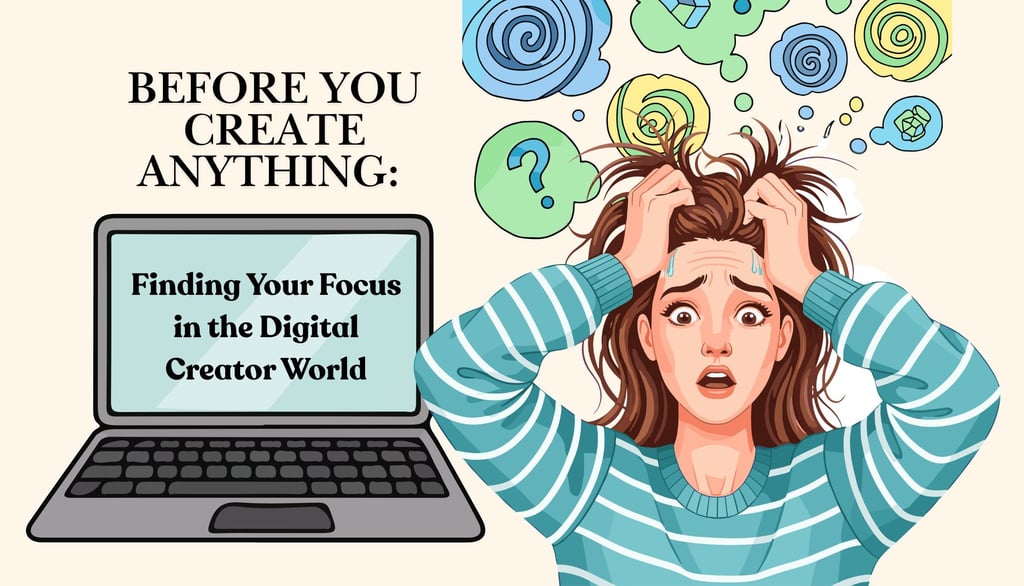
You sit down to “start,” and suddenly you have 27 tabs open. One is a course on TikTok, one is a newsletter tool, one is a creator’s income report, and three are half-watched videos titled “Do THIS to blow up.”
Your notes app is full of ideas, your camera roll is full of drafts, and your cart is full of tools you haven’t used. You feel excited about the potential for passive income through digital products, then stuck. Sound familiar?
I get it. I've been there. Actually, I'm still there some days.
The digital creator world offers so many possibilities that it's paralyzing. Should you create digital planners? Design t-shirts? Build a course? Start a blog? Launch a YouTube channel? Sell templates? Try affiliate marketing? All of the above?
Here's what no one tells you when you're starting out: the biggest mistake isn't choosing the wrong path—it's trying to walk down all of them at once.
This post gives you a simple way to find focus before you post, film, or start creating digital products. Not forever. Not the perfect niche. Just a clear direction you can commit to for the next 30 days. That one choice saves time, saves money, saves you from burnout, and sets up your digital product business for long-term success.
Why most creators get stuck before they start (and how focus fixes it)
Most beginners don’t fail because they lack talent. They fail because, lured by low production costs, they try to do everything at once.
A few common traps show up fast:
Copying what’s trending, even if it doesn’t fit you
Trying to build a following on every platform at the same time
Buying gear and software before you know what you’re making
Starting complex online courses before you’ve shipped anything small
Focus is the opposite of chaos. It looks like one target audience, one problem, one content lane, and one first offer. That’s it.
If you’re wondering whether you’re unfocused, here are quick signs:
Constant re-branding: new name, new colors, new “angle” every week.
Lots of drafts: you create, tweak, delete, repeat.
No publishing: months of planning, little to show.
You don’t need more ideas. You need a container for your ideas, so they can turn into posts, products, and progress.
Let's Talk About the Overwhelm
When I first started transitioning from traditional media to the digital space, I made every beginner mistake in the book. I tried to do everything simultaneously because I was afraid of missing out on the "best" opportunity.
I started designing print-on-demand products while also creating digital planners, building a website, learning about SEO, trying to grow a Pinterest account, and researching affiliate marketing. I was consuming content faster than I could implement anything.
You know what happened? Nothing. Well, nothing good anyway.
I was busy, exhausted, and going nowhere. I had seventeen half-finished projects and zero completed ones. I knew a little bit about everything and not enough about anything to actually succeed.
Sound familiar?
The digital creator space is designed to make you feel like you're falling behind. Every day there's a new platform, a new trend, a new "must-try" strategy. But here's the truth that took me too long to learn: you don't need to do everything. You just need to do one thing well.
Why Choosing Your Focus Matters
Think about it this way: if you walked into a restaurant and the menu had 500 items ranging from sushi to pizza to tacos to fine French cuisine, would you trust that kitchen? Probably not. You'd wonder how anything could be good when they're trying to do everything.
The same principle applies to you as a creator.
When you try to do everything, you:
Spread yourself too thin to master anything
Confuse your potential audience about what you actually offer
Burn out before you see any real results
Never build enough momentum in one area to succeed
But when you choose one focus area and commit to it for a meaningful period (I'd suggest at least 90 days),
you...
Actually finish things
Build real skills and expertise
Create a body of work that attracts the right people
Start seeing results that motivate you to keep going
Choose your focus in one hour with the "People, Problem, Proof" method
When you’re new, you don’t need a complicated framework. You need a fast way to pick a direction that’s clear enough to create around.
Set a timer for one hour. Open a notes doc. Then work through these three words: People, Problem, Proof.
Your goal is one sentence you can paste at the top of your notes, like a headline for your next month. This one-hour exercise provides quick market research to get you started.
A simple template:
I help (People) with (Problem) using (Proof).
Example: “I help first-year teachers plan calm mornings using a 15-minute routine I used during my first semester.”
Not perfect. Just clear.
The Questions No One Asks (But You Should)
Before you create your first product, launch your first shop, or start your first website, ask yourself these questions. Write down your answers. Be honest. This isn't about what sounds impressive or what some guru says you should do.
1. What do I already know something about?
You don't need to be an expert, but you probably have more knowledge and skills than you realize.
I spent twenty years in traditional media—designing ads, understanding what makes people click, learning consumer psychology. I didn't think that mattered in the digital world at first, but it turned out to be my biggest advantage.
What's your background? What have you spent years doing, even if it was "just your job"? What do friends ask you for help with? What comes easily to you that others find difficult?
Your existing knowledge is valuable. Don't overlook it just because it seems ordinary to you.
2. What do I actually enjoy doing?
This matters more than you think.
If you hate writing, starting a blog-focused business is going to be misery. If you're not visual, forcing yourself to create Instagram content will drain you. If you love designing but hate marketing, you need to factor that into your strategy.
Passive income isn't actually passive—it requires work upfront and ongoing maintenance. You need to enjoy at least part of the process, or you won't stick with it long enough to succeed.
What activities make you lose track of time? What parts of the creation process excite you? What would you do even if you weren't getting paid (at least at first)?
3. What fits my current life situation?
Be realistic about your time, energy, and resources.
If you work full-time and have young kids, you probably can't commit to creating daily YouTube videos. If you have limited funds, investing in expensive software or inventory might not be wise starting out.
If you have two hours a week, what can you actually accomplish? If you have $100 to invest, where will it go furthest? If you're exhausted by 8 PM, when will you actually do this work?
There's no shame in starting small. In fact, starting small is smart. You can always scale up later.
4. What problem do I want to solve (or help solve)?
The best digital products and services solve problems or make life easier for someone.
You don't need to cure cancer or solve world hunger. Maybe you help busy moms meal plan. Maybe you create budget templates for people who hate spreadsheets. Maybe you design printable wall art that makes people's homes feel more personal.
What frustrates you that you've figured out a solution for? What do you wish existed when you were learning something? What small problem could you help solve for others?
Understanding Your Options (Without the Hype)
Let me break down the main "lanes" in simple terms, with the real talk about what each one actually involves:
Digital Products
Creating and selling downloadable items like planners, templates, printables, worksheets, or guides.
Real talk: Low startup cost, total creative control, but requires design skills (or learning Canva) and understanding what people actually want to buy. Sales can be slow at first.
Print-on-Demand
Designing products (t-shirts, mugs, phone cases) that someone else manufactures and ships when ordered.
Real talk: No inventory needed, but profit margins are lower than you'd think. Very competitive. You need strong designs and smart marketing.
Content Creation (Blog/YouTube/Podcast)
Building an audience through valuable content, then monetizing through ads, sponsorships, or selling your own products.
Real talk: Takes the longest to see income, requires consistency, but can build a real community and multiple income streams over time.
Templates & Tools
Creating Canva templates, Notion templates, spreadsheets, or other tools people can customize.
Real talk: Great passive income potential if you create something people genuinely need. Requires understanding the platforms and what users struggle with.
Websites & Design Services
Building simple websites or offering design services for small businesses or fellow creators.
Real talk: More active income than passive, but you can charge more per project. Requires technical skills but has steady demand.
Turn your focus into a simple creator plan you can actually finish
A focus statement is nice, but it’s not the finish line. It’s a map.
Now you turn that statement into a plan you can repeat without thinking. This is where content connects to creating digital products, because your posts and your product should solve the same problem.
Here’s the simplest structure:
One platform
One content type
One small product idea
You’re building a straight path from attention to trust using content marketing to your first sale of digital products through an online store, even if that sale comes later.
Pick one platform and one content type for the next 30 days
Pick the platform you’ll actually show up on for social media marketing. Not the one you “should” use. This choice helps you build a following.
A short menu of content types:
Short videos (talking head, screen share, voice-over)
Carousels (step-by-step slides)
Emails (one helpful message to your email list, once or twice a week)
Blog posts (search-friendly how-to posts)
Podcast clips (short tips pulled from longer audio)
Consistency beats intensity. A light pace that works for most beginners is 2 to 3 posts a week.
Make it easier with a weekly theme. Example: Mondays for quick tips, Wednesdays for a mistake to avoid, Fridays for a simple template or checklist preview. Your brain relaxes when it knows what day it is.
Start small with creating digital products that solve one problem
Big products like membership sites are tempting because they feel “real.” But small products get finished, and finished products teach you what people want. They also pave the way to larger offers like online courses later.
Beginner-friendly product ideas:
Content calendar templates for “I don’t know what to post”
Budget starter templates for “my money disappears”
A meal prep shopping list for “I never have dinner ready”
A job interview answers bank for “I panic in interviews”
A gym plan checklist or simple ebook for “I don’t know what to do”
One rule keeps you moving: build Version 1 in a weekend and set it up in your online store. Keep it simple, useful, and easy to deliver, perhaps through an automated email sequence.
Then improve it after feedback, not before. Your first product is not your legacy. It’s your starting line.
Stay focused when shiny ideas show up (without killing your creativity)
New ideas will show up the moment you commit. That’s not a character flaw. That’s a creative brain doing what it does.
The goal isn’t to block ideas. The goal is to stop letting ideas pull you off the road every time they honk.
You need a system that protects your plan while keeping your spark alive. Think of focus like a campfire. You can add wood. You just don’t sprint into the forest every five minutes.
Use an "idea parking lot" so you can keep creating
Create one place to store ideas: a notes doc, a Notion page, a notebook, anything.
Label it “Parking Lot.”
Rule: when a new idea hits, write it down in one minute, then go back to your current task. You can only choose from the parking lot during a weekly review. Treat these stored ideas as digital assets, and consider legal protection for the most valuable ones down the line.
This does two things at once. It keeps you focused today, and it proves to your brain that good ideas won’t be lost.
Set 3 rules that protect your time and money
Rules sound strict, but they’re freedom. They stop you from re-deciding the same thing every day.
Pick three that fit your life.
Here are options that work well for beginners:
No new software tools for 30 days. Use what you have.
No new platforms until you publish 12 posts. Earn the right to expand.
No new product until you ship one freebie or mini-offer. Finish small first, and stick to basic design principles so you don’t overcomplicate the look.
Write your rules where you’ll see them. If you have a full-time job, kids, or school, your rules should protect your energy, not punish you.
Do a quick monthly check-in and adjust on purpose
At the end of 30 days, don’t panic and pivot. Review like a calm scientist.
Track three simple metrics:
Did you publish consistently?
Did people respond (likes, replies, saves, DMs, comments)?
Did you learn what they need (new questions, repeated struggles, clear words)?
Stay the course if you’re showing up and getting any signal at all. This builds toward recurring revenue and lets you scale your business once consistency is locked in.
Change only if one of these is true:
You hate the topic and dread it every time
You can’t reach the audience (you have no access to them)
You get zero response after steady effort (same plan, same pace, for a month)
A smart shift beats a random pivot.
My Personal Journey to Focus
Let me tell you what finally worked for me.
I stopped trying to do everything and asked myself: "What combines my existing skills with something I genuinely enjoy, that I can realistically do with my current schedule?"
My answer: Digital products, specifically planners and templates, with a focus on helping fellow beginners.
Why? Because I have design experience from my traditional media background. I enjoy the creation process. I can work on designs in the evenings without needing perfect lighting or video equipment. And I wish someone had taught me the "in-between" steps when I was starting out.
That doesn't mean it's the right answer for you. But it was my right answer, and having that clarity changed everything.
Your Action Step (Yes, Just One)
Here's what I want you to do right now—not tomorrow, not next week, right now:
Pick ONE area from the options above that genuinely interests you and commit to exploring it for the next 30 days.
Not six months. Not a year. Just 30 days.
During those 30 days:
Consume content specifically about that one area
Join one community focused on it
Create one thing (even if it's terrible)
List it somewhere (even if no one buys it)
After 30 days, check in with yourself. Did you enjoy it? Did it fit your life? Do you want to keep going?
If yes, commit to another 90 days and go deeper.
If no, that's okay. You learned something valuable, and now you can try something else with zero guilt.
The Permission You're Looking for
I know you're probably waiting for someone to tell you it's okay to not have it all figured out yet.
So here it is: It's okay. You don't need to have it all figured out.
You don't need a perfect plan. You don't need the best equipment. You don't need to know everything before you start. You just need to pick a direction and take the first step.
The digital creator world will still be here tomorrow with all its options and opportunities. New platforms will launch. New trends will emerge. You're not missing out by focusing on one thing—you're actually setting yourself up to succeed.
I'm still learning. I'm still figuring things out. I still have moments where I wonder if I should try something completely different. But the difference now is that I give myself permission to focus, to go deep instead of wide, and to build something meaningful instead of dabbling in everything.
You can do the same.
What's Next?
Once you've chosen your focus area, you'll need specific guidance on how to actually get started in that space.
That's where the next steps come in:
Interested in digital products? Check out my roadmap for creating your first digital product from start to finish.
Curious about print-on-demand? I've broken down exactly how POD works and how to choose your first platform.
Want to build your online presence? Learn why a simple website matters and how to start without overwhelm.
But first, take a deep breath. You're not behind. You're not too late. You're exactly where you need to be—at the beginning, with curiosity and willingness to learn.
That's more than enough to start.
Let's do this together.
Over to you: What area are you leaning toward? What's holding you back from choosing? Drop a comment below—I read every one, and I'd love to hear where you're at in your journey.
Contact Us
digigirlstudio@gmail.com
DigiGirl Studio© 2026. All rights reserved.